.png)

.jpg)
JUSTIN TRUDEAU'S FAILED MULTILATERAL RELATIONS: IMPACT ON CANADA'S 2025 ELECTIONS
Rakshana R
Introduction
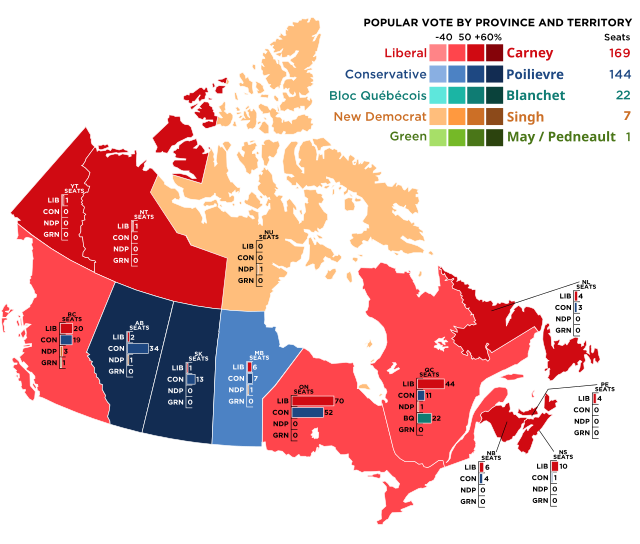
In April 2025, Mark Carney assumed office as Canada's Prime Minister following Justin Trudeau's decade-long administration, marking the Liberal Party's fourth consecutive victory. When Trudeau announced his resignation in January this year, Carney was sworn in as the Interim Prime Minister following the in-house elections. He then called for a snap election in April 2025, which was initially scheduled for October. The past few years of Trudeau's tenure faced challenges due to domestic discontent over the housing crisis, increasing migration levels and the government's inability to provide welfare goods. This is one of the factors that disrupted the state contract between Trudeau and Canada's population. However, a key factor for his sudden resignation was the failure of multilateral relations, particularly with the US and India, which had a profound impact on the electoral outcome. This article contends that Trudeau's failed foreign policy and his inability to maintain key international partnerships have weakened Canada's diplomatic influence and catalysed a significant electoral backlash. By examining bilateral tensions with Washington and New Delhi, we argue that these diplomatic failures-combined with domestic discontent over housing and cost-of-living-contributed substantially to the conditions that led to Trudeau's resignation and Carney's rise to power.
Trudeau's Foreign Policy Achievements
Trudeau was initially recognised for his liberal idealism, with an emphasis on multilateralism, climate action, human rights, and other elements of liberal ideology. He signed a trade agreement with the United States and Mexico (USMCA), the replacement for NAFTA, which reinforced economic cooperation and strengthened the country's global presence. Canada also joined the Comprehensive and Progressive Agreement for Trans-Pacific Partnership (CPTPP), which expanded trade opportunities in the Asia-Pacific region. Canada is one of the 195 signatories to the Paris Agreement, which aims to combat dynamic climate conditions through collective action (Government of Canada, 2016). However, in due course, dynamics shifted drastically. The diplomatic fallout with the US was catalysed by Trump's return to office for a second term, and the escalated tensions with India were spurred by the assassination of Khalistani Leader, Hardeep Singh Nijjar. Failed multilateral relations, which were considered a key to Canada, became the very medium for Trudeau's fallout.
Canada - United States Bilateral Relations
Canada and the US have historically had close relations of strategic, economic, and political interdependence. The relations can be classified into three distinct phases: Trump's first presidency, Joe Biden's presidency, and Trump's second term in Office.
Canada-US relations under Trump 1.0 (2016-2020)
Immediately after assuming office, Trump had embraced economic nationalism, which deteriorated bilateral relations between the two countries. He soon imposed a 25 per cent tariff on Canada's steel and aluminium in 2018, further straining relations. In response, Canada imposed retaliatory tariffs on American goods and services, signalling the heightened trade tensions between the two countries. This eventually made Canada's structural dependency on the US visible and highlighted Trudeau's inability to negotiate a solution that could have preserved Canada's sovereignty.
Canada-US relations under Joe Biden (2021-2024)
Under Joe Biden's presidency, US-Canada relations improved, bringing temporary stability through a policy of multilateral cooperation. However, it clearly showed to the public that Trudeau's success and administration were directly dependent on the American President and his interests in the state. The character, ideas, and identity of the American President have shaped the political stability and trajectory of Canada. This reduced Canadian trust in Trudeau.
Canada-US relations during Trump 2.0 (2025-Present)
The trade war between the two countries resumed soon after Trump assumed office for a second term, followed by his public criticisms of Trudeau on several political occasions. Tensions escalated when Trump abruptly left the G7 Summit in June this year, tagging Trudeau as "weak and dishonest", where he also mentioned he wanted Canada to be treated as the 51st state of the US (Borger & Perkins, 2018). By the end of 2024, the economic pressure, along with diplomatic humiliation, had led to the decline of the Liberal Party and Trudeau, which eventually forced the party to choose an eligible and trustworthy candidate who could rejuvenate the party's growth.
Canada - India Bilateral Relations
Canada's diplomatic relations with India deteriorated during Trudeau's tenure owing to the assassination of the Khalistani Separatist Leader, Hardeep Singh Nijjar on 18 June 2023, in Surrey, Canada. Khalistan is a political separatist movement seeking an independent Sikh nation carved out from the Indian state of Punjab, where these ideational followers are known as Khalistanis (BBC News, 2023). Right after the assassination, Trudeau alleged the involvement of the Government of India. It was a move that reflected pressure from the Canadian Sikh community and a stand to defend Canada's sovereignty. Trudeau also stated that he had substantial evidence to prove his claim. This statement weakened bilateral ties as India condemned his act. India also made serious allegations against Trudeau for supporting anti-India groups and stated that the accusation was totally absurd and politically intended (NDTV, 2025).
This diplomatic erosion further intensified as Canada has not publicly released detailed evidence to substantiate Trudeau's claims, which India continues to reject. "The responsibility for the damage that this cavalier behaviour has caused to India-Canada relations lies with the Prime Minister Justin Trudeau alone," said Randhir Jaiswal, spokesperson of India's Ministry of External Affairs (TOI News Desk, 2024). This eventually led to strained India-Canada relations, questioning Trudeau's foreign policy credibility and diminishing his legitimacy. Domestically, the event gave Canadians a perception of Trudeau's inability to manage foreign relations and arguably considered him diplomatically weak. The strained bilateral relations between India and Canada accelerated the downfall of both Trudeau and his party.
Analysis Of Failed Bilateral Relations Affecting Voting Behaviour
Trump's America First policy reflects his realist orientation, which prioritises protecting national interests and sovereignty by formulating unilateral policy actions, thereby eroding America's multilateral cooperation. This has reduced Canada's economic and diplomatic space by demonstrating Trudeau's inability to manage the economic and social dependence on America. As some analysts argue, this resulted in changed voter behaviour during the 2025 elections to counter the imbalance and build an autonomous state. Additionally, Trudeau's response was more reactive than proactive, which strained his identity in both domestic and international political forums. The tariff war affected industries and the agricultural sector in Canada, leading people to believe that Trudeau had failed to protect their economic interests. These factors ultimately led to the requirement for the next Prime Minister to maintain cordial relations with world nations to preserve Canada's territorial sovereignty and integrity.
On the other hand, the diplomatic crisis with India over the killing of Nijjar has disrupted relations, impacting the diaspora. Approximately 40% of Canada's long-term international students are from India, who contributed $ 31 billion to Canada's GDP in 2022, highlighting the importance of economic interdependence between the two countries (Global Affairs Canada, 2024). Rather than resolving the issue, a diplomatic freeze was imposed, where Canada expelled Indian diplomats, and in return, Canadian diplomats were asked to leave (Global Affairs Canada, 2024). And, from a cultural aspect, the identity of Indo-Canadians, whose homeland was alleged to have committed a crime, felt disregarded by the government.
All these political and economic factors further escalated mistrust among the voters, resulting in a division of votes. The diplomatic fallout resulted in the votes becoming deeply divided, particularly among students, businesspeople, and migrant workers, as they encountered disrupted visa processes, trade losses, and a breakdown in people-to-people connections due to their differences. Canada, with nearly 5% of the Indo-Canadian population, had to endure the consequences of diluting the Indian diaspora's voting.
Carney's credibility appealed to the electorate:
The public was dissatisfied with both Trudeau's failure to protect the national identity and his sequential errors, internally and externally. This demanded an eminent leader who could normalise the severed ties with India and reduce Canada's economic and social dependency on the US. It eventually led to Trudeau's resignation before the end of his mandate, enabling Carney, elected by the Liberal Party, to lead the interim government. Carney had previously served as the Governor of the Bank of Canada and the Governor of the Bank of England, which ensured people of his capabilities. Moreover, his criticism of Trump and his policies aligned with the electorate, projecting him as effective and competent enough to lead Canada in the future.
On the other hand, the Conservative Party, led by Pierre Poilievre, resonated with Donald Trump's political style, as a core nationalist who frames "Canada First", a more aggressive personality, which raised concerns among the electorate. The public might have feared that aggressive nationalism would worsen the tensions within and outside Canada. Even though Conservatives won the popular vote, they were unable to win in different ridings, ultimately resulting in a Liberal victory. Mark Carney, after assuming office, re-engaged with India during the G7 summit, sparking an improvement in bilateral relations. Both nations promised to promote bilateral relations in areas such as the economy, science, and nuclear cooperation, similar to previous times (Political Science Solution, 2025). While India and Canada had constructive engagement, Canada's relations with the US have deteriorated, where tariff levels were increased further. This ongoing political conflict is challenging policymakers to formulate a solution to resolve bilateral tensions.
CONCLUSION:
To survive and preserve sovereignty in contemporary geopolitics, it is crucial for states to maintain constructive multilateral cooperation and engagement within the international system, as emphasised in liberal institutionalism. This article's analysis of Canada's 2025 elections argues that if a state exhibits an inability to achieve its national interests while maintaining cordial relations with world powers, it faces significant political, economic, and integral consequences. Our evidence suggests that Trudeau's mishandling of trade tensions with the US and the diplomatic fallout with India-particularly over the Nijjar killing-had demonstrable impacts on Canada's trade relationships, its domestic policies, and its diaspora communities. The structural dependency of Canada vis-a-vis America, combined with strained ties to India, exposed vulnerabilities that resonated with voters.
Yet, the Liberals secured office again, in part due to the credibility and technocratic experience that Mark Carney brought to the table. Canada faces a complex path forward: it has to balance multilateral ties with both the US and India and at the same time reduce structural economic dependence on Washington. The 2025 elections shows that voter behaviour is shaped by both international pressures and domestic dissatisfaction. The electorates may reward leaders perceived as capable of navigating competing international demands, even when past foreign policy performance has been contested.
-Rakshana R is an MA International Studies student at Symbiosis School of International Studies, Pune
References
Borger, J., & Perkins, A. (2018, June 10). G7 in disarray after Trump rejects communique and attacks "weak" Trudeau. The Guardian. https://www.theguardian.com/world/2018/jun/10/g7-in-disarray-after-trump-rejects-communique-and-attacks-weak-trudeau
Cecco, L. (2025, April 3). Canada to counter "unjustified" US tariffs with 25% taxes on US cars, says Carney. The Guardian. https://www.theguardian.com/world/2025/apr/03/canada-us-cars-tax
Global Affairs Canada. (2024, June 20). Appendix 4 - Data tables for 2022. In The economic impact of international education in Canada - 2022 update. https://www.international.gc.ca/education/report-rapport/impact-2022/appendix-annexe_4.aspx
Global Affairs Canada. (2024, October 14). Minister Joly announces expulsion of Indian diplomats related to ongoing investigation on violent criminal activity linked to the Government of India [News release]. https://www.canada.ca/en/global-affairs/news/2024/10/minister-joly-announces-expulsion-of-indian-diplomats-related-to-ongoing-investigation-on-violent-criminal-activity-linked-to-the-government-of-india.html
Environment and Climate Change Canada. (2015, December 31). Paris Agreement [Program description; international treaty]. Government of Canada. https://www.canada.ca/en/environment-climate-change/services/climate-change/paris-agreement.html
India-Canada relations 2025: A new chapter in bilateral ties - Political Science Solution. (2025, June 20). Political Science Solution. https://politicalsciencesolution.com/india-canada-relations-2025-a-new-chapter-in-bilateral-ties/
Khalistan: Why are some Sikhs calling for a separate homeland in India? (2023, September 19). BBC News. https://www.bbc.com/news/world-asia-india-66852291
Mishra, S. (2025, January 6). How Justin Trudeau's allegations against India set stage for his downfall. NDTV. https://www.ndtv.com/world-news/justin-trudeau-canada-how-justin-trudeaus-allegations-against-india-set-stage-for-his-downfall-7410411
Thomas, M. (2025, April 28). Mark Carney leads Liberals to their fourth consecutive win. The Conversation. https://theconversation.com/game-change-canadian-election-mark-carney-leads-liberals-to-their-fourth-consecutive-win-253721
Trudeau alone responsible for damage to India-Canada relations: MEA. (2024, October 17). The Times of India. https://timesofindia.indiatimes.com/india/only-confirms-india-on-trudeaus-admission-of-not-providing-hard-proof-on-nijjar-killing/articleshow/114297476.cms