.png)

.jpg)
From Machismo to Senora Presidenta: Historic Win in Mexican Election
Adwita Dixit
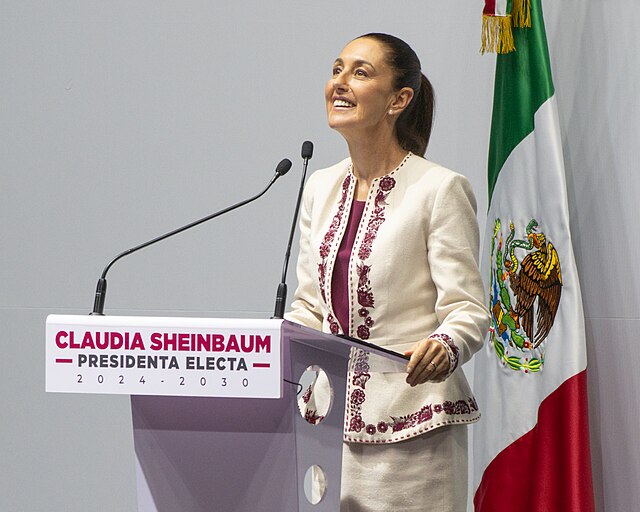
Contrary to what Joseph Stalin said, "those who vote decide nothing, those who count the vote decide everything", people of Mexico decided to vote and create history for themselves. The 2024 Mexico election are no less than a historic event that shaped Mexico's political landcape by electing its first female president. On June 2nd, 2024, Mexico elected Claudia Sheinbaum and her victory resonates with wider trends in women's political participation across Latin American and beyond, where patriarchies still dominate. Sheikh Hasina's leadership in Bangladesh, Christine Carla Kangaloo's presidency in Trinidad & Tobago, or even Michelle Bachelet's win in Chile set examples that women leaders can coexists within technocratic governance. She is a climate scientist and former mayor of Mexico City, who now shoulders the responsibility as the Senora Presidenta of the nation. She is not only the first woman president but also the first person of Jewish origin to hold office (CNN Editorial Research, 2024). In a country whose roots are shaped by the Catholic heritage and patriarchy, Sheinbaum's presidency disrupts not one but multiple hierarchies. This election represents a fundamental rebranding of power dynamics within the state. The fact that gets overlooked in political commentary is that Claudia Sheinbaum wasn't simply appointed-she was elected.
This is't a trivial fact but marks a transformative movement: that the people of Mexico have chosen to trust a woman over a man to lead their nation. The newly elected head of state defies the 200 years of conditioned Mexican history. A history that speaks of machismo and gender inequality (Sengupta, 2024) was out ruled by a drastic shift in Mexico's socio-political arena. For the first time in the history of Mexico both leading presidential candidates were women, Claudia Sheinbaum and Xochitl Galvez (Grant, 2024). Latin American nations, are known for a complex gender dynamic in politics, but this development in Mexico reflects the adapted gender inclusivity and structural changes within the male dominated region. On paper, progress appears to be stronger than what women face in practice, but on the ground, the story is a bit blurred. This region witnessed powerful figures such as Dilma Rousseff in Brazil and Cristina Fernandez de Kirchner in Argentina, but their political tenures resulted in a conservative and often misogynistic backlash (Jalalzai et al., 2022). This backlash was triggered by their departure from office and the ensuing legal disputes, revealing that increased legislative representation does not necessarily translate into changes in ground realities (Jalalzai et al., 2022). Within Mexico women continue to face harassment, even politicians aren't protected it which depicts the deep roots of patriarchy and power dynamics of the Mexican political culture. Violent crimes and femicides rates have remained persistently high. Nearly 93 per cent of sexual violence cases go unreported or are barely investigated (Pandit, 2025). In this context, electing a woman doesn't end gender violence, just as electing a person of colour doesn't erase racism, but transformational leadership does.
What sets her apart is not just identity but the approach to her leadership. During her tenure as the mayor of Mexico City, she put efforts, among other social programmes, into expanding public daycare, improving transport safety for women, and supporting single mothers-policies that go beyond tokenism in politics (Tamaki, 2021). Her proposed models address how to combat organised crime by combining federal forces, federal and state prosecutors and state police in joint law enforcement operations (International Crisis Group, 2024). Her victory, from the lens of progressive legal structures and violent realities, feels more impactful, as it has the potential to bridge the gap between the two and develop a policy-focused approach to deal with impunity in the nation. Her leadership style, shaped by data-driven governance and technocratic policy thinking, aligns well with the global trends. Her environmental expertise aligns with sustainable development diplomacy, probably leading Mexico to lead climate-related negotiations.
Global politics treats women as passive and apolitical. This comes from a very patriarchal mindset, where "women are peaceful, nurturing, and emotional, and they don't wage wars or run states", but this is a myth; women are capable of running a state and fighting (Cohn & Enloe, 2003). Realists and, to some extent, even liberalists in IR treat wars and diplomacy as departments of machismo and keep women out of negotiation tables, but history tells another story-women have led revolutions, headed armies, and brokered peace. Women leaders focus on inclusive and peace oriented governance, for example Prime Minister Sanna Marin of Finland, has a gender equal cabinet and it also rank high on the World Economic Forum's Annual Gender Gap Report Index(Niethammer, 2019). Similarly Italian Prime Minister Giorgia Meloni's leadership, reflects a broader European trend of women leaders navigating political authority in a traditionally masculine institution (Giorgi et al., 2023). She is seen among world leaders and challenges the realist notion that power must be coercive.
Claudia Sheinbaum will fight, but maybe not as aggressively as patriarchy views it. She is rooted in a scientific approach, policy negotiation and long-term strategic thinking. Instead of using military power, she chooses to fight structural violence through institutional change and social justice. While the People of Mexico didn't just vote for a new president, they voted to unlearn the fact that women don't fight. Her scientific approach and commitment to social justice reframes what is means to "fight". People often say soft politics isn't good or desirable, but gendered leadership isn't about softness or femininity; it's about resolving a conflict with a new perspective, which isn't always military. The feminist in the IR discourse emphasises how power dynamics are embedded in global politics. Historically politics has always privileged men and their understanding of power dynamics, where strength is equated with war and cooperation is considered soft. J. Ann Tickner's reconstruction of the patriarchal lens states that security lies not in military accumulation but human welfare and peace. Sheinbaum challenges patriarchy by normalising empathy, cooperation and use peaceful tools of statecraft in her policies. Constructivists, on the other hand, remind us that norms like "who leads" are socially constructed and can be reframed - highlighting that Claudia Sheinbaum's presidency isn't just historic in Mexican politics, but a symbolic representation of global leadership itself.
Mexico might now be rebranded altogether, not as a passive recipient of the US hegemony or a state locked in narco-politics and populism, but as constructive, progressive, and pluralistic at its core. Mexico is Latin America's second-largest economy, which is also a G20 country, and this position of the nation makes it a tactical geopolitical player in the world. Having a female head of state speaks of progress in terms of diplomacy. Her winning symbolises that the world is inching towards more inclusivity, cooperation, empathy, and peace as the geopolitical tensions between Mexico and the USA persist over immigration and crime cartels, which is fuelled by Washington's whimsiness. Claudia has been able to put up a balanced act, which seems a commendable diplomatic move. She has been taking measures to placate Trump by making concessions and providing him with visible, short-term policy wins. Given this appeasement approach, Senora Presidenta has been described by some commentators as a "Trump whisperer", as she had a constructive dialogue with the U.S. President (Hoffmann, 2025). Considering how strained and tight Mexico's economic position is, Sheinbaum's data-driven governance model could prove pivotal in sustaining the economy. With evident recession in the country, her ability to implement welfare policies within a strategic framework of diplomacy might define the success of her presidential tenure in terms of Mexico's growing image in the Global Power system.
Sheinbaum's victory is a case study that demonstrates how national elections can influence global trends. It reinforces the idea that gender is not a domestic issue, but it is pivotal to how different actors of politics comprehend power, diplomacy and governance. It provides a food for thought for deliberations on how gendered governance lead to more peaceful and inclusive global relations. As the world watches, Mexico's 2024 election historic win offers a blueprint for feminist leadership in the 21st century.
-Adwita Dixit is an MA International Studies student at Symbiosis School of International Studies, Pune
References
CNN Editorial Research. (2024, November 6). Claudia Sheinbaum Fast Facts. CNN. https://www.cnn.com/2024/11/06/world/claudia-sheinbaum-fast-facts
Cohn, C., & Enloe, C. (2003). A Conversation with Cynthia Enloe: Feminists Look at Masculinity and the Men Who Wage War. Signs Journal of Women in Culture and Society, 28, 1187-1107. https://doi.org/10.1086/368326
Giorgi, E. D., Cavalieri, A., & Feo, F. (2023). From Opposition Leader to Prime Minister: Giorgia Meloni and Women's Issues in the Italian Radical Right | Article | Politics and Governance. https://www.cogitatiopress.com/politicsandgovernance/article/view/6042
Grant, W. (2024, May 31). Mexico election: Meet the women leading the race for president. https://www.bbc.com/news/articles/cxrr597e907o
Hoffmann, Dr. J. (2025, April 24). What can be Learned from the Mexican President Claudia Sheinbaum's Handling of Trump? https://www.giga-hamburg.de/en/press/what-can-be-learned-from-the-mexican-president-claudia-sheinbaums-handling
International Crisis Group. (2024). The Election Outlook (The Generals? Labyrinth:, pp. 27-28). International Crisis Group. https://www.jstor.org/stable/resrep60216.8
Jalalzai, F., Kreft, B., Martinez-Port, L., dos Santos, P. A. G., & Smith, B. M. (2022). A tough woman around tender men: Dilma Rousseff, gendered double bind, and misogynistic backlash. Frontiers in Political Science, 4. https://doi.org/10.3389/fpos.2022.926579
Niethammer, C. (2019, December 12). Finland's New Government Is Young And Led By Women-Here's What The Country Does To Promote Diversity. Forbes. https://www.forbes.com/sites/carmenniethammer/2019/12/12/finlands-new-government-is-young-and-led-by-women-heres-what-the-country-does-to-promote-diversity/
Pandit, P. (2025, May 13). Violence against Women in Mexico. Vision of Humanity. https://www.visionofhumanity.org/violence-against-women-in-mexico/
Sengupta, T. (2024, October 3). Who is Claudia Sheinbaum? 5 things about Mexico's first female president. Hindustan Times. https://www.hindustantimes.com/trending/who-is-claudia-sheinbaum-5-things-about-mexico-s-first-female-president-101727948336305.html
Tamaki, L. (2021, November 8). Claudia Sheinbaum Pardo on lessons from Mexico City. The Economist. https://www.economist.com/the-world-ahead/2021/11/08/claudia-sheinbaum-pardo-on-lessons-from-mexico-city