.png)

.jpg)
South Korea's 2025 Snap Elections: Implications and Outcomes
Ishangi Chauhan
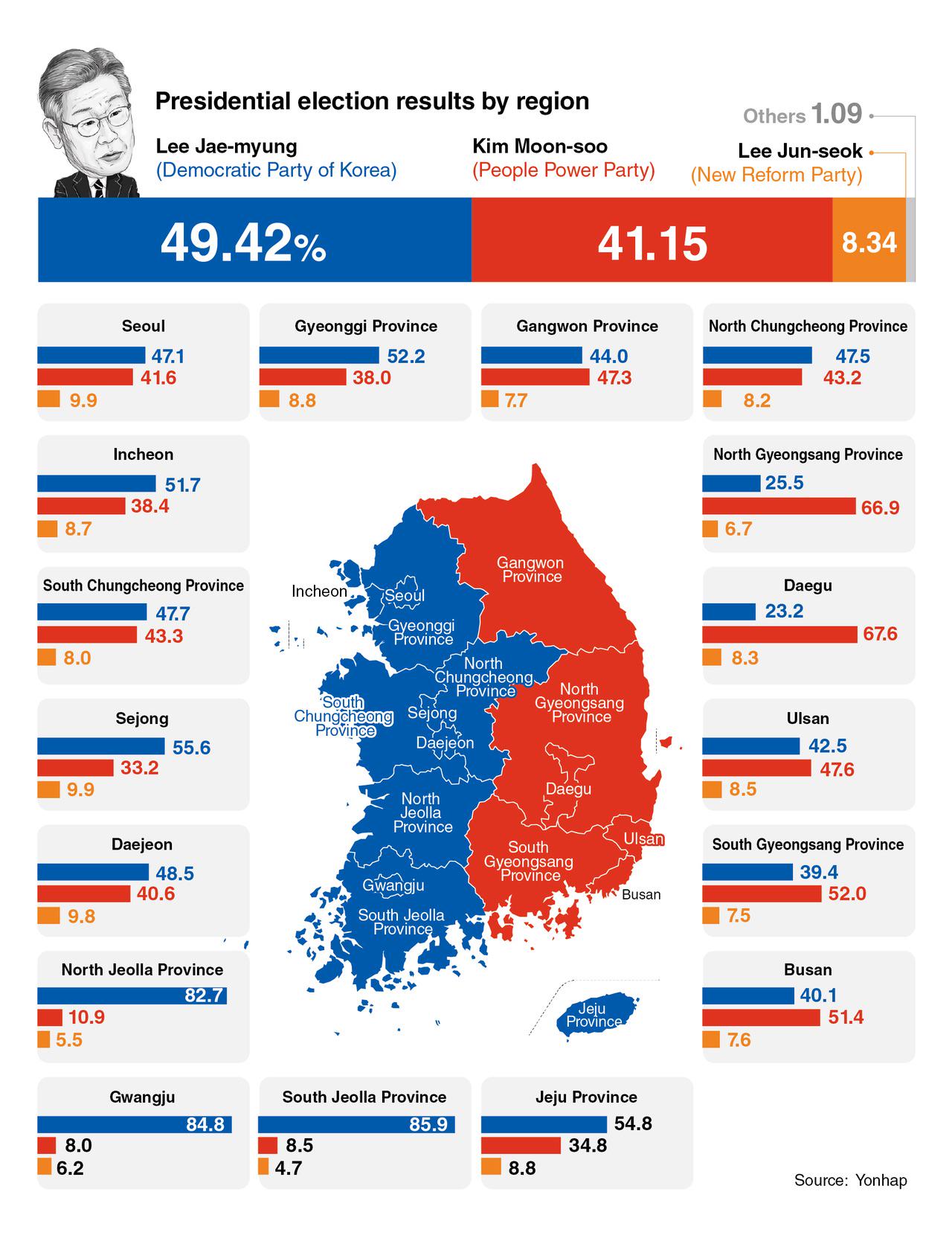
The June 3, 2025, South Korea snap elections not only curbed political and democratic instability but also put a lot of pressure on the new administration to face domestic and international challenges. The snap elections were triggered due to the sudden and short-lived Martial law by former president Yoon Suk Yeol in December, and the constitutional and political crisis it caused, which resulted in his impeachment and removal from office in April ("South Korea Election Results 2025: Who Won, Who Lost, What's Next?" 2025). This created an urgent need for new leadership to bring down the period of political turbulence and public outrage. Lee Jae Myung was elected as the next president from the left-leaning Democratic Party of Korea (DPK), which secured a victory with 49.42% of the vote (Cha & Lim, 2025). The previously prolonged absence of the head of state had created an urgent need in the nation to be addressed on a strategic basis. Due to the nature of the elections, the president had to take office on the very next day (June 4), with no transition period, requiring him to address the political and economic state of the country on an immediate basis (Cha & Lim, 2025).
On December 3, 2024, former President Yeol of the People Power Party (PPP) declared martial law at night, without consulting his party or informing the Parliament. Martial law is the replacement of civilian government by military rule and the suspension of civilian legal processes for military powers. Yeol justified this declaration as a response to the opposition being involved in anti-state forces and threats from North Korea. This decision was not welcomed, and chaos erupted in the country, resulting in clashes between the civilians and the deployed armed forces. It was after midnight that the parliament passed a ruling stating that the martial law was null and void. The then opposition leader and now current President, Lee Jae Myung, played a significant role in informing civilians about the situation through social media and, as reported, even climbing the parliament wall to vote against the martial law.
The whole Martial law chaos became the driving issue in the snap elections. Myung promised to punish those involved in the act, which ultimately led to his victory. The other key election issues included the reshaping of presidential powers in the wake of the December event, low economic growth in the face of US tariff threats, political turmoil, and weak domestic demand. Other issues included relations with its neighbour, North Korea, its security ally - the U.S., and its largest trading partner, China. Issues such as low birth rate and women's rights also made their way to the list (Rasheed, 2025). In light of these challenges, Myung pledged to ease tensions with North Korea through the restoration of military hotlines. He also promised to tighten relations with the U.S., and China and pursue a balanced diplomatic approach; implement tighter presidential controls; introduce a shorter working week; and invest heavily in research and development and artificial intelligence ("South Korea Election Results 2025: Who Won, Who Lost, Wha's Next?" 2025). These areas had to be taken into consideration when working on the economic upliftment and the stabilisation of democracy.
The Lee Jae Myung administration faces a very daunting future for its economy, since it has been hit financially due to the political instability. The top priority is the economy which, according to the Bank of Korea, has seen growth slashed to 0.8% (Cha & Lim, 2025). Furthermore, the already slowing export demands have been hit by the U.S. - China trade war, both nations being vital for the export economy. Myung will barely have any time to renegotiate the tariffs imposed by the U.S. and will have to negotiate trade deals before the deadlines. The prolonged political instability will affect the confidence of investors in the country. Moreover, the stock markets remain affected, and the South Korean won fell to its lowest levels in roughly two years against the U.S. dollar (Power, 2024).
The high rates of tariffs by the U.S. on South Korea introduced new strains into the Japan-US-South Korea security and economic alignment. This was taken as an opportunity by the Chinese to initiate talks with South Korea and Japan over promoting regional trade, for which the respective trade ministers met in March for the first time in five years (Cha & Lim, 2025). Some observers fear that South Korean economy is stifled in the same way as Thailand due to its dysfunctional leadership, owing to political turmoil since 2006. The tech giants Samsung and Hyundai have been unable to contribute significantly because their stocks have long been viewed as undervalued compared to their global peers (Power, 2024). Despite these challenges, South Korea's economic and political institutions demonstrated their decision-making power through the swift and smooth rejection of martial law. Even in a time of economic instability, the quick working of the institutions helped showcase the country's willingness to maintain democracy and made people believe in decency in its role as a protector of democracy. This also reflects in their relations internationally.
Lee Jae Myung views the country's alliance with the U.S. as the foundation of South Korean diplomacy. The U.S. showed its concerns regarding the martial law chaos and reaffirmed its support for its ally. This support can help Lee negotiate on tariffs and discuss the North Korean policy. Lee has acknowledged the strong relations with Japan and promised not to interfere with the growth achieved during the Yoon administration, and to adhere to the diplomatic agreements made before. Lee has called for a balanced approach with China, maintaining good ties, and underlining its geographic and economic importance. This approach clashes with the U.S., which warned its allies not to engage with China for economic benefits and defence ties with the U.S (Cha & Lim, 2025). Lee mentioned cooperation with North Korea would be difficult, but military hotlines would be reestablished. No other alternative method of engagement with North Korea has been mentioned.
The Myung administration has a long way to go to restore the nation's image and uplift the economy. There are concerns that civilians would remain a little wary of the new president due to his abrupt assertion of power through the martial law declaration in December of last year. His administration will have to prove its worthiness through its actions in restoring the nation's image and helping the economy get back on track. With half of the world facing pressure from tariffs, it is highly unlikely for South Korea to secure a deal on favourable terms. South Korea's partnerships with Japan and China for regional trade can be a factor that influences international relations. This can prove to be good for the countries, but the allies would have to face the wrath of the U.S. Trump has been very graciously presenting the countries with gifts of tariffs, but none wants to be the bearer of them. The politics in South Korea would have been facing a different scenario had Yoon Suk Yeol denied his resignation and his own party had supported him. In the end, as the fourth-largest economy in Asia, South Korea is expected to regain stability over time, and much would depend on whether Lee performs his duties sincerely and does not become swayed by the power he gains as president.
-Ishangi Chauhan is an MA International Studies student at Symbiosis School of International Studies, Pune
References
Cha, V., & Lim, A. (2025, June 3). South Korea's New President: Frying Pan to Fire [Commentary on a website]. CSIS. https://www.csis.org/analysis/south-koreas-new-president-frying-pan-fire
Power, J. (2024, December 5). South Korea's economy rattled by martial law decree. Aljazeera. https://www.aljazeera.com/economy/2024/12/5/after-pledging-renewal-south-koreas-yoon-shakes-faith-in-economy
Rasheed, Z. (2025, May 31). South Korea's snap presidential election 2025: All you need to know. Aljazeera. https://www.aljazeera.com/news/2025/5/31/south-koreas-snap-presidential-election-2025-all-you-need-to-know
South Korea election results 2025: Who won, who lost, what's next? (2025, June 3). Aljazeera. https://www.aljazeera.com/news/2025/6/3/south-korea-election-results-2025-who-won-who-lost-whats-next