.png)

.jpg)
The 2024 U.S. Elections and the Future of the Western Alliance
Diya Shankar and K. Tejaswini
Research Question:
Why has the election of Trump as the US president led to an increase in uncertainty among allies?
The 2024 Election Shockwave
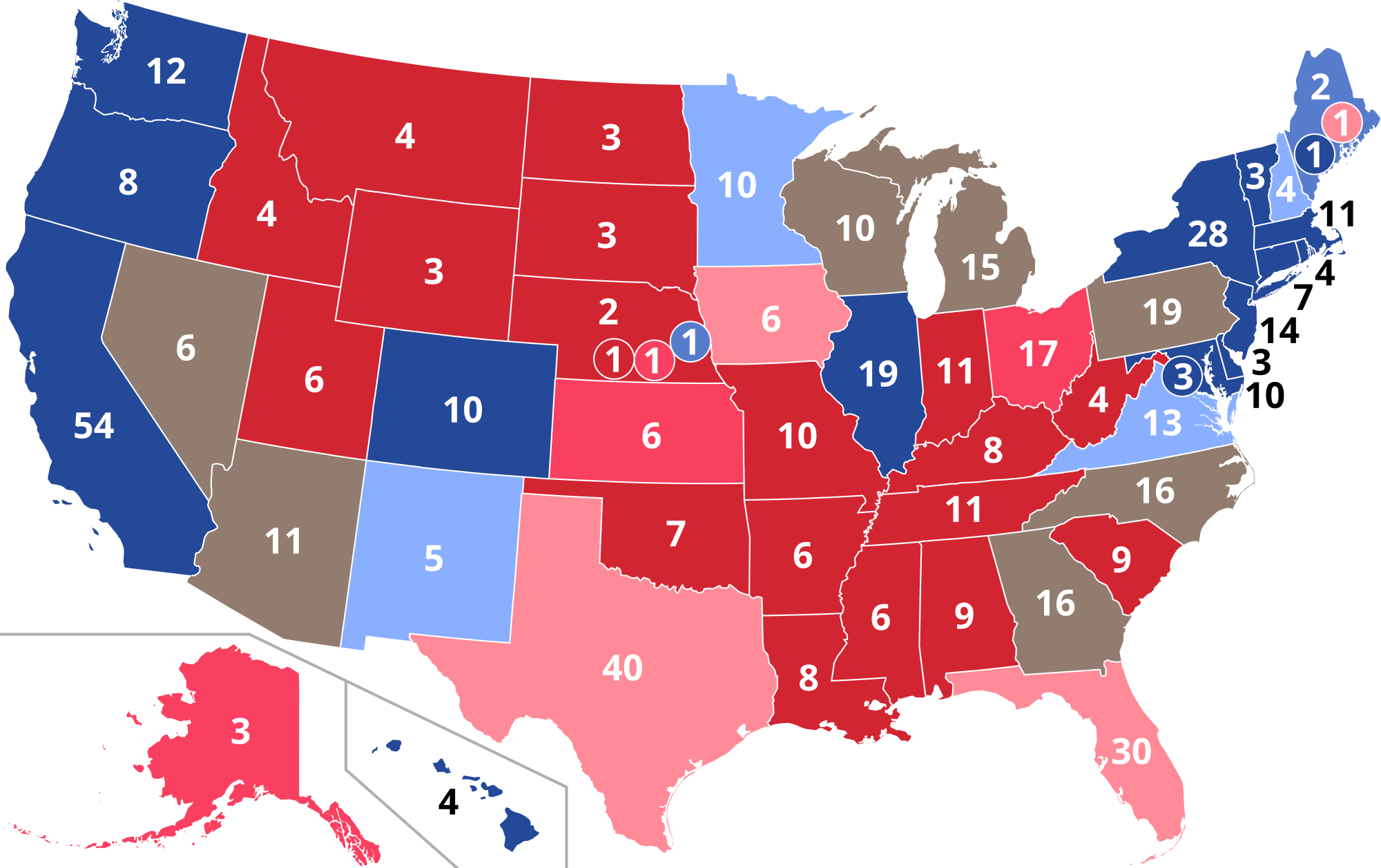
In the 2024 US elections, Donald J. Trump made his way once again into the White House as the former President beat his opponent, former Vice President Mrs. Kamala Harris, with an approximate margin of 1.5 percent (BBC News, n.d.). This result brought significant waves both within the country and abroad, as the comeback of the previous Republican President came with new national policies. The aftereffects of these policies have been the prime subject of discussion on many fronts and have also become a topic of disagreement and a cause for concern for the allies of the US.
The uncertainty and volatility post the Trump election surpass just the gamut of unpredictability in decision-making. To appreciate this more nuanced dissonance that seemed to be unfolding between the US and its allies, this blog uses game theory concepts of finite and infinite games as a framework to analyse the evolving dynamics of the period. This is informed by insights from Simon Sinek in his TED talk, What Game Theory Teaches Us About War. (TED Archives, 2016)
Game Theory and Geopolitics:
Game Theory: The study of Game Theory is the study of strategic interactions between two (or more) players where, in the players, are assumed to be rational and working towards the attainment of the best possible result, i.e., the optimum result. Much application is seen within the field of economics and has shown its capabilities within the field of International Relations and Geopolitics.
Finite Games: A finite game is a type of game wherein the number of players, the rules, and the endpoint are fixed. The game ends with a well-defined termination. Illustrations of such games are the use of strategies by countries to realize their (short-term) primary interests. In this regard, the ultimate aim of such strategies is to win, which means that the game has a well-defined end. Such a game can be found in geopolitical negotiations wherein all parties apply tactics to yield the most favourable outcome, thereby winning the negotiations.
Infinite Games: An infinite game is a type of game within which the number of players, the rules of the game and the endpoint of the game remain undefined. That means that the total number of players participating within the game alongside the rules of the game remain unknown. This also means that the game does not hold a definite endpoint/result. The United States' principal objective of maintaining its global hegemony exemplifies the most essential concept of an infinite game. Within this framework, the nation cannot realistically achieve a definitive positive outcome, i.e., it cannot emerge victorious in the game. This is because its aspiration to retain its position as the preeminent power within the international arena remains an ongoing process that can only come to an end in the unfortunate scenario of either the collapse of the United States of America or an uncontrolled spiral of global events.
Strategic Shift and Allied Uncertainty
The 2024 US elections surprised the international community as the world had widely expected a close and highly polarising contest, but his re-election nevertheless surprised many observers. These results sparked multiple speculations and an unexpected phenomenon, that is the deterioration of US's credibility within the eyes of its western allies. The occurrence of this event was highlighted during the Trump-Zelensky spat which took place earlier in this year visibly shook the international community. President Trump's stance was widely perceived by critics as tilting towards the Russian narrative. The feud occurred during the talks of finalizing the minerals deal during which President Trump and Vice President JD Vance of the United States were seen clashing with Ukrainian president Volodymyr Zelenskyy, with Vice President Vance going as far as to accuse the Ukrainian President of gambling with World War 3 (Yadav, 2025). The conflict was met with a disgruntled response from several US allies, including the EU.
Similar reactions occurred when the US announced trade tariffs against some countries, including those in the European Union. The US imposed an extra 25% tariff on Canada, its neighbour and a NATO ally (The White House, 2025). The US's allies released several statements in respect of the action by the US. Though most of them condemned the actions of the US, other pleaded for immediate diplomatic discussion over the tariffs. However, disapproval, anxiety, and shock were common in all of them. In both the cases, a fog of uncertainty and anxiety was expressed by not only the international society but also allies of the United States, especially the Western allies. Such situations naturally provoke the following questions, why do such strategies raise alarms, particularly among nations who have traditionally been considered as its closest allies?
The answer to this question lies within the portrayed image of the United States amongst its allied nations through perspective of game theory. Throughout history, US has portrayed itself as a global guardian, a Big Brother or a paternal figure, often providing aid and relief in political matters of other nations and acting as a mediator in conflict resolution. This has enabled the country to maintain its hegemonic status, fulfilling one of its core goals, which may also be accounted as an infinite game. To play this game, the US employed several tactics, including promoting and aiding humanitarian efforts, promoting democratic and liberal ideologies, and setting up reformatory plans such as the Marshall Plan of 1948. These strategies were positively perceived by the international community and served as pillars for building the US image as a global leader. These tactics also operated in creating intricate but invisible rules that enabled the continuation of the US's infinite game of remaining the global hegemon.
These rules were relatively simple to maintain up until the end of the Cold War. This was because, within its infinite game, the United States had a single main opponent-the former Soviet Union-which led the majority of US strategy and rules during this era. Therefore, when its opponent collapsed-the dissolution of the Soviet Union in 1991-the rules of the US infinite game were bound to be drastically altered as it lost its main opponent. Since then, the United States has faced no single central opponent, but multiple unidentified foes and a fast-changing world order.
This was in addition to the destabilization of the previous global arena and the diversification of its adversaries, which paved ways for the formulation of newer US strategies-influencing changes within the US policies. However, changes to the original US persona remained the same until the 2024 re-election of President Trump. The country was able to do this because it maintained alignment with its previous regulations while trying to adapt with shifting geopolitical realities. However, under the guidance of the Trump administration, notably within his second term, the United States foresaw a major realignment within the regulation of its infinite game. This can be seen within the application of strategies like the Trump Tariffs (2025), which not only targeted its opponents but also several close allies. These moves have been widely interpreted by analysts as a shift in the perception of the US from a positive light to one of global uncertainty. This shift also began to prioritize the sustenance of US national interests more aggressively.
What is more while satisfying its own national interest, the United States under the Trump administration appears to have deviated from what can be understood, in game-theoretic terms, as a secondary goal of sustaining Western dominance. One of the clearest examples is Trump's repeated criticism of NATO, including statements suggesting that the US might not defend a NATO member that fails to meet the alliance's defence-spending target. This shift in US strategy is more than unusual; it marks a striking departure from how much of the world traditionally viewed America as a guiding, protective force that many countries turned to for leadership and support. In its effort to play the infinite game of preserving its global dominance, the Trump administration began to drift away from this traditional identity as a guardian of international stability. In doing so, it increasingly appeared to sidestep its secondary role of shielding its Western allies and upholding the broader Western order.
Conclusion
The re-election of former Republican President Donald J. Trump at the end of the 2024 United States elections marked the beginning of an overwhelming geopolitical whirlwind. This move sparked widespread speculation and outrage across national and international forums, simultaneously revealing the increasing rift between the United States and its Western allies. The growing uncertainty was caused by the then-nationwide change in national strategies and tactics of the US under the Trump administration. At that point, it shifted the nation's focus from its leading goal and seriously altered the perception of the US across international borders. The highly confusing nature of Trump's strategies added to the chaos since his rules of the game began drifting further from their previous position, adding to the unease of Western US allies.
-Diya Shankar is an MA International Studies student at Symbiosis School of International Studies, Pune
References
BBC News. (n.d.). US presidential election results 2024. BBC News. https://www.bbc.com/news/election/2024/us/results
The White House. (2025, April 2). Regulating imports with a reciprocal tariff to rectify trade practices that contribute to large and persistent annual United States goods trade deficits. https://www.whitehouse.gov/presidential-actions/2025/04/regulating-imports-with-a-reciprocal-tariff-to-rectify-trade-practices-that-contribute-to-large-and-persistent-annual-united-states-goods-trade-deficits/
Yadav, D. (2025, August 18). Zelensky returns to the White House to meet Trump after horrific Oval Office spat: A recap. Hindustan Times. https://www.hindustantimes.com/world-news/what-happened-when-zelensky-last-met-trump-at-white-house-recalling-the-oval-office-spat-101755510971587.html
TED Archives. (2016, November 9). What game theory teaches us about war | Simon Sinek [Video]. YouTube. https://www.youtube.com/watch?v=0bFs6ZiynSU