.png)

.jpg)
Cameroon's 2025 Elections: Power, Politics, and the World's Oldest President
Nandana Joy
Introduction
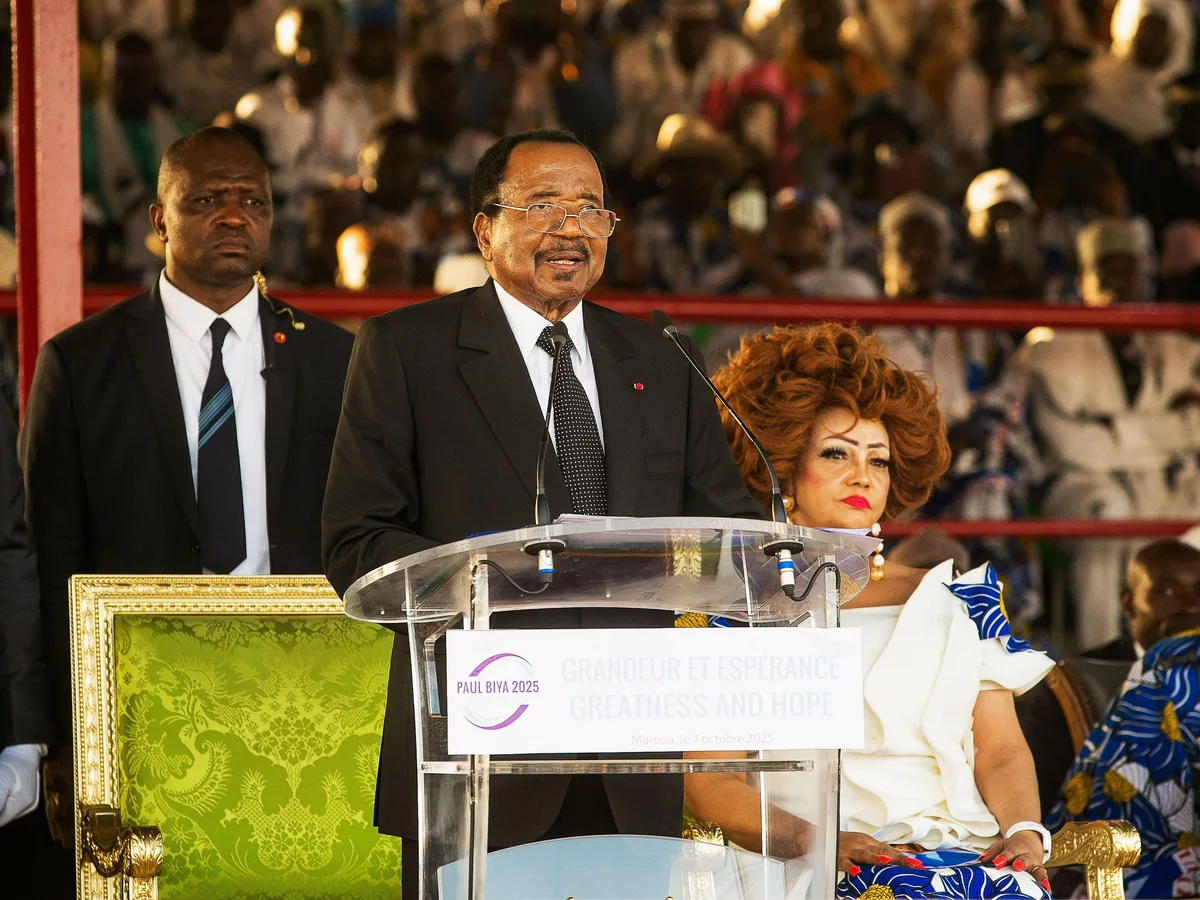
Paul Biya's grip on power demonstrates how personalised authoritarian rule dismantles democratic rights and competition in Cameroon. As of October 12, 2025, Paul Biya has secured his eighth continuous term as Cameroon's president; at 92, Biya has now been in power for over four decades, since 1982. His persistence in securing re-election once again reflects an entrenchment in power, especially during a time of political stagnation (The Guardian, 2025). Biya's regime style of a personalised authoritarianism has been marred by allegations of electoral fraud and limited political freedom. For this year's election, the Cameroon Election Commission undermined opposition candidates, and concerns regarding Cameroon's political trajectory and governance model have become prominent. The continued institutional obstruction of democratic function in the country only aggravated the public's dismay, fatigued by the political plateau. The muted international response by global actors further entrenches the 2025 election. Keeping these factors in mind, this article examines Biya's four decades of rule, the weakened opposition, and the implications for Cameroon's 2025 elections, including Biya's position and those of his electoral counterparts.
Historical foundations of power
Cameroon's post-independence journey from 1960 established the institutional framework for Biya's eventual authoritarian federation. Cameroon attained independence from France in 1960, and was led by President Ahmadou Ahidjo, a frontrunner of the Cameroonian National Union, now known as the Cameroon People's Democratic Movement or CPDM. Cameroo's post-independence political evolution paved the way to a centralisation of authority and personalised rule; a sensible path to Biya's pragmatised authoritarianism. With this early consolidation of power in a single-party system, it would enable Biya's later electoral manipulation and wins. Equipped with French education, Paul Biya entered the Cameroonian civil service in the 60s, quickly rising through the administrative ranks. Ahidjo appointed him Prime Minister in 1975, an action that promoted ethnic and linguistic representation. Upon Ahidjo's resignation in 1982, Biya assumed the role of president as per the law of constitutional succession (Paul Biya, 2025).
Biya's authoritarian control
Biya transformed Cameroon's political foreground from nominal power-sharing to distinct presidential dominance through strategy, eliminating rivals and empowering institutional arrests. Although the transfer of power seemed subtle enough, a deep political tension grew between Biya and Ahidjo. A falling out and an attempted coup in 1984 led to Biya's centralised power over the then CNU, rebranding to CPDM in the 1990s. Post Cold War pressure for democratisation urged Biya to introduce multi-party reforms as a concession on domestic fronts, an inconsequential action that only maintained his grasp on power. Electoral infrastructure and laws were gradually redesigned to maintain Biya's influence; weakening opposition and allegations of fraud and voter suppression followed Biya's successive re-elections (Freedom House, 2024). The 2025 election reinforced this pattern, where Biya's successful re-election came as a result of state repression, managed pluralism, and a blatant ignorance of public opinion and requirement.
Opposition entities and state repression
Within Biya's structure of personalised authoritarianism, the existence and function of the opposition is crucial to keeping the presiding regime in check. The initial emergence of Maurice Kamto as the most credible opponent to Biya's power allude to the idea of opposition mobilisation. Issa Tchiroma Bakary, Akere Muna, and Bello Bouba Maigari were notable candidates in the elections, with Tchiroma Bakary coming in second in the elections. With 35.2% of the votes, Tchiroma has been vocal of his opposition, and the possibility of a tampered result (BBC, 2025). He also highlighted the civic and political unrest in the nation after the election results, urging a national lockdown to show non-compliance with the Biya regime (Reuters, 2025). While national security forces have been accused of detaining hundreds and killing dozens of protestors, according to UN and media reports, Biya issued a public statement calling for peace, a rather dismissive message that asked the public to put the elections behind them (BBC, 2025). However, the opposition entities continue to be weakened, with a biased election commission that is loyal to the incumbent president, and a media structure that funnels selective material to the public, diminishing the effect of the opposition. In allowing oppositions to prevail but within boundaries set by the ruling regime, this is a clear case of managed pluralism. The opposition in Cameroon functions within the limits of Biya's controlled democracy, reinforcing an illusion of competition.
Electoral obstruction and bias
The 2025 electoral environment in Cameroon shows how state entities obstruct opposition parties from participating, turning elections into legitimation rituals than a competition. Election Cameroon (ELECAM), Cameroon's election commission has been met with allegations of political bias and obstruction of electoral competition (Freedom House, 2024). Rather than performing its role as a neutral institution, ELECAM operates as an extension of Biya's regime, working to exclude opposition candidates and sway electoral procedures (GJSS, 2019). Kamto and the CRM continue to be omitted from mainstream media, their supporters detained. Combining legal obstruction, media blackouts, and selective repression ensures that opposition movements do not build the momentum required to challenge Biya's power.
The African Union's message and support for President Biya's re-election only reinstates an acceptance of the authoritarian regime, calling for social cohesion and peace (African Union, 2025), but no mention of the legitimacy of the electoral process. A thorough investigation would be beneficial; looking at regions like the Anglophone concentrated areas, where protests and dissent led to Biya's unpopularity, recording a majority of the votes counted in Biya's favour alludes to unlawful electoral functioning (International Crisis Group, 2025). The Biya regime seems persistent in its longstanding tradition of subduing dissent, instead of welcoming political contestations (The Guardian, 2025).
Electoral fatigue and youth disillusionment
The consistent suppression of Bakary's opposition reveals the public's fatigue with respect to the electoral process itself. Decades of predetermined electoral outcomes have generated widespread political apathy, particularly among the Cameroonian youth, far removed from the idea of meaningful change. (BBC, 2025) President Paul Biya's inherent authoritarian rule has battered the public's faith in the concept of elections. This overall apprehension in electoral politics was a sensible precursor to the sharp decline in voter turnout, in both national and local elections (BBC, 2025). The young masses under the age of 40, which make up close to 60% of Cameroonian population, continue to be disillusioned and disconnected from political representation and the election process, a condition that sees no respite soon (Freedom House, 2024). Having witnessed only Biya's presidency, they perceive elections not as opportunities for change, but as premeditated performances that legitimise continued authoritarianism (BBC, 2025).
The normalisation of a predetermined election outcome has resulted in an electoral fatigue, an ignored response to Biya's authoritarian rule. In the name of civic and social participation, elections tend to cultivate a sense of futility; a governmentally controlled social space means heavily controlled media and policing of public opinion, discourse and activism. The affected public feels inadequate in their power, in deciding who gets to govern them, especially the young majority (International Crisis Group, 2020). Cameroonians have, then, unfortunately accepted the stagnancy of their political power, giving unto an unchanging status quo. The youths' perspective balances between electoral fatigue and visible frustration; a certain young graduate expresses her stance on the re-election, where she "... grew up knowing him as the president, so seven years of additional time in power will not change anything" (BBC, 2025). For Cameroonians who have only been subjected to Biya's rule since 1982, the re-election seems to have exhausted the democratic aspirations of citizens and opposition parties alike.
International inaction and political facades
International actors prioritise geopolitical stability over democratic accountability, sequentially enabling Biya's regime to maintain a mask of legitimacy without drawing substantial reforms. The United Nations, European Union, and African Union have repeatedly called for electoral reform and social human rights protection, but Biya's regime remains untouched (Human Rights Watch, 2019). This recognised pattern reveals that international organisation often issue rhetorical condemnations that help them claim they engaged with unrest. While they deliberately avoid sanctions or diplomatic pressure on Cameroon that might destabilise its authoritarian status quo (Lansing Institute, 2025). Extensive documentation of political and electoral malpractice, restrictions of political freedom, and uninformed detentions do not translate into diplomatic sanctions or calls for justice. Western forces appear willing to tolerate Biya's regime system in exchange for regional security cooperation and economic access.
There is however a response from Cameroon's European counterparts, with France's Foreign Minister message on the political repression around the time of the elections: "We believe [...] that all persons arbitrarily detained since the beginning of the electoral process be released in order to preserve national cohesion" (Reuters, 2025). Additionally, the United Nations issued a statement that resonates with the Secretary-General's thoughts on the post-election violence, urging ''...all political stakeholders and their supporters to exercise restraint, reject violence and refrain from any inflammatory rhetoric and hate speech'' (UN, 2025). The stark absence of a specific critique of Cameroon's political unrest only enables the Biya regime to display a likeness of democratic sincerity while simultaneously diminishing any democratic substance (The Guardian, 2025). With a sharp rise in living costs and unemployment, the Cameroonian government now faces debilitating pressure to transparently address these concerns and pacify the effects of the violent, political dysfunction.
Conclusion
Paul Biya's eighth term cements a political model that brandishes regime continuity over democratic renewal, trapping Cameroonians between authoritarian control and ineffective international advocacy. With the October 2025 elections, the political inertia of the incumbent President Paul Biya followed the design of decades past. While international actors favoured a lukewarm response towards the democratic inconsistencies in Cameroon, the local population is growing weary of their political conditions; the lack of governmental transparency, healthy opposition, and of individual rights are marked concerns that worry the public. Any goals for social betterment lie in the hands of those indisposed to the public's anxieties. This analysis attempts to demonstrate how Biya has concentrated his power through institutional capture and neutralized oppositions. It is evident that the corrosion of the public's faith in the electoral system, and their overall exhaustion of an unchanging ruling regime only set up the Cameroonians for a re-election that will likely bring forth a controlled political continuity than democratic competence and reform. Without international pressure, will Biya's eighth term in personalised governance be challenged, or will the public's patience rupture in the face of authoritarianism?
References
Amnesty International. (2019, October 5). Cameroon: Maurice Kamto and others must be released. https://www.amnesty.org/en/latest/press-release/2019/10/cameroon-release-of-maurice-kamto-and-several-detainees/
Al Jazeera. (2025, July 26). Cameroon bars main challenger to longtime leader from presidential race. . https://www.aljazeera.com/news/2025/7/26/cameroon-bars-main-challenger-to-longtime-leader-from-presidential-race.
African Union. (2025, October 28). Chairperson of the African Union Commission congratulates H.E. President Paul Biya on re-election and calls for national dialogue in the Republic of Cameroon. https://au.int/en/pressreleases/20251028/auc-chairperson-congratulates-he-president-paul-biya-re-election
BBC. (2025). As it happened: Anger, protests and calls for calm as Paul Biya wins again. https://www.bbc.com/news/live/cx2k4w58w91t
Freedom House. (2024). Cameroon: Freedom in the World 2024. https://freedomhouse.org/country/cameroon/freedom-world/2024
Yuh, J. K.. (2019). The Loopholes, Shortcomings and Controversies of Elections Cameroon (ELECAM) and its Law within the Electoral Dispensation of Cameroon. Greener Journal of Social Sciences. https://doi.org/10.15580/GJSS.2019.2.071019133
International Crisis Group. (2020). Cameroon's Anglophone Crisis: How to Get to Talks?
International Crisis Group. (2025). Defusing Cameroon's Dangerous Electoral Standoff. https://www.crisisgroup.org/africa/cameroon/defusing-cameroons-dangerous-electoral-standoff
Lansing Institute. (2025, October 29). Cameroon's 2025 presidential election: Results, reactions, and implications. https://lansinginstitute.org/2025/10/29/cameroons-2025-presidential-election-results-reactions-and-implications/
Reuters. (2025). Cameroon opposition leader Tchiroma says loyal soldiers escorted him to safety. https://www.reuters.com/world/africa/cameroon-opposition-leader-tchiroma-says-loyal-soldiers-escorted-him-safety-2025-10-31/
Reuters. (2025). France concerned about Cameroon violent repression against protests. https://www.reuters.com/world/africa/france-concerned-about-cameroon-violent-repression-against-protests-2025-10-29/
The Guardian. (2025, July 20). The world's oldest president is running again: Can anyone stop him? https://www.theguardian.com/world/2025/jul/20/worlds-oldest-president-paul-biya-cameroon-election
United Nations. (2025, October 28). Statement attributable to the Secretary-General - on Cameroon's presidential election. https://www.un.org/sg/en/content/sg/statements/2025-10-28/statement-attributable-the-secretary-general-cameroons-presidential-election