.png)

.jpg)
Mexico Enters a New Era: The Historic Election and the Dawn of Sheinbaum's Super-Majority
Nidhi Yadav
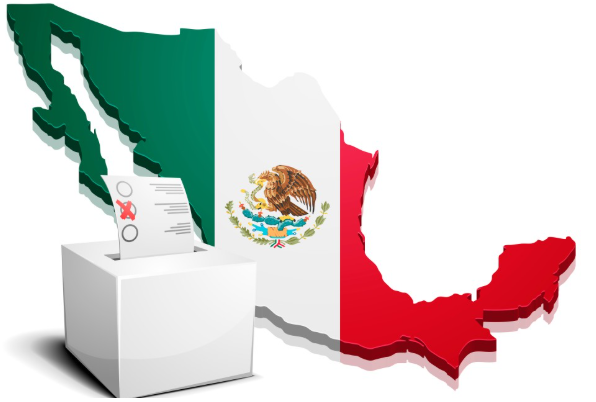
The 2024 general election in Mexico was an event of historic value as it essentially changed the overall political landscape of the country and established the hegemony of the incumbent National Regeneration Movement (Morena) party. Claudia Sheinbaum, a climate scientist and former Mayor of Mexico City, contested the presidency on June 2, 2024, and won in a landslide to become the first woman to hold the position. Her victory was not only a personal win but a clear popular legitimation to continue the outgoing President Andres Manuel Lopez Obrador's Fourth Transformation (4T) initiative. The 4T initiative aims to reduce corruption, inequality, restore the sovereignty of the nation, and put the poor first, which is now supported by a massive concentration of authority within the legislative system (Falcon, 2025)
The election outcome was clear: Sheinbaum easily won with nearly 60 per cent of the popular vote, a larger margin than her mentor, Lopez Obrador, had won in 2018 (Felbab-Brow & Garcia, 2024). The non-governmental coalition (corporation), a very diverse but ultimately varied coalition headed by Xochitl Galvez, convincingly lost. Outside of the presidency, the Morena-led alliance, including the Labour Party (PT) and the Green Ecological Party (PVEM), obtained a super-majority in the Chamber of Deputies, and in the Senate just short of a 2/3 majority (Reuters, 2024). This legislative hegemony gives the ruling coalition authority to change the constitution practically by command, which was not witnessed in Mexico for decades of one-party rule under the Institutional Revolutionary Party (PRI). It is generally considered that Sheinbaum's victory was a resounding endorsement of Lopez Obrador's six-year tenure. His popularity, based on the growth of social programs, minimum wages, and an anti-corruption message, shifted well to his hand-picked heir. Sheinbaum has pledged to construct the second floor of the Fourth Transformation as an indicator that she would continue along the main policies of her predecessor, that is, to empower the poor and marginalised through economic means (Garcia, Krakow, & et al., 2024).
The Mechanics of Hegemony: Legislative Super-Majority
The composition of the 66th Legislature (2024-2027) is the definitive story of the election. The primary results indicated that the coalition between Morena-PT-PVEM has secured a two-thirds majority in the lower house. To confirm the super-majority in the upper house, the final Senate count mandates the chapulineo (party-switching) of a minimal number of opposition legislators. Now the ruling party can bypass any opposition to constitutional amendments. With a super-majority, President Sheinbaum can move forward with the 4T agenda's radical elements, which include the 20 constitutional initiatives put forward by ALMO in his final month of tenure. The most disruptive proposal of the 4T agenda was judicial reforms, which include the direct popular election of nearly 2,700 judicial positions, 881 federal judges and 1.800 local-level roles across 19 states (Zissis, 2025). This measure was designed for combating corruption and elite capture. Still, it was widely criticised by legal scholars, domestic business entities and international actors for introducing partisan politics into selecting the judiciary. Thereby, dismantling the independent judiciary institution and compromising the rule of law
A proposal for the dissolution of autonomous bodies was laid to eliminate the constitutionally autonomous regulatory and transparency bodies, such as the Instituto Nacional de Transparencia, Acceso a la Informacion y Proteccion de Datos Personales (INAI) and the Comision Federal de Competencia Economica (Cofece). This would absorb their function into federal ministries. This would result in limiting the accountability and access to information, which would affect the transparency in public functions. This proposal has sparked international concerns, as these bodies are key pillars of democracy; thus, the New York City Bar Association urges the Mexican government to reconsider the proposal (Bar, 2024). Another element includes military expansion, after reversing the years of effort to establish a professional, civilian police force. The transfer of the Guardia Nacional (National Guard) was formalised in September 2024 under Lopez Obrador, just before the administration transition.. This measure would further entrench the armed forces in public safety and security and civilian administration.
The Road Ahead: Challenges for the First Female President
Claudia Sheinbaum, a climate scientist and former mayor of Mexico City, steps into the presidency with the largest mandate in Mexico's history, but immediately after the election, her administration is confronted by monumental challenges that will test her leadership and ability to navigate the opportunities in the future, putting aside her predecessor's shadow. Organised crime and security remains one of the most intimidating domestic crises. The 2024 election cycle was the most violent in the present history of the country, marked by the assassination of many candidates that were mostly at the local level. This highlights the growing power of organised crime to invade and subdue the political process. While the security strategy developed by Sheinbaum, which involves dealing with the cause of violence and enhancing intelligence, led to her success as the mayor of Mexico City, the challenge of extending that achievement to the whole country, where cartels are deep-rooted, will be her administration's defining task.
Sheinbau's administration inherits a favourable macroeconomic environment, propelled by nearshoring- the manufacturing and supply chain relocation closer to the U.S market and strong remittances, but was hampered by the potential domestic obstacles. The state oil company, Pemex, is vast and heavily indebted, wiping out government finances, and the nation is experiencing chronic energy and infrastructure shortfalls, which pose a threat of paralysing growth even in the industrial sector (Werner, 2024). Moreover, the government deficit overrun by the previous government, coupled with the promise not to finance any significant fiscal reforms, leaves the government with limited resources necessary to finance its grandiose social programmes and infrastructure projects (Langston, 2024).
Despite the political uncertainty, Mexico has derived an enormous advantage from the nearshoring trend, whereby companies relocate their manufacturing and supply chain business closer to the consumers of North America and avoid the Chinese export tariffs charged by the US and the geopolitical risk of unpredictability (Deslandes, 2024). It has led to a boom in the foreign direct investment (FDI), especially in the automotive and Electrical appliances industries. The administration of Sheinbaum has made this parallel by announcing strong intentions of the 'Made in Mexico' projects that will dominate high-tech sectors such as electric cars, semiconductors, satellites, and artificial intelligence (Singh, 2025).
The Mexico 2024 election provided an incredible contradiction. It produced the first woman president of Mexico, a victory of the gender-parity enactment that has been pushing women gradually toward power, but it has likewise solidified a governing platform that analysts fear might undo years of democratic accretion. The leadership of Sheinbaum has a chance to bring some actual change, either centralising the powers of the state and delegitimising independent authorities' control, or utilising her knowledge of science and political capabilities to solve not only the most complex issues but also the most demanding ones of Mexico, such as security or climate change. The future of the New Mexico order is heavily reliant on how President Sheinbaum strikes a balance between her allegiance to the 4T project and its charismatic leadership and the immediate/pragmatic needs of operating a modern complex country. The world continues to wait and see whether her strong mandate would bring about stable progressive rule or rogue executive domination.
-Nidhi Yadav is an MA International Studies student at Symbiosis School of International Studies, Pune
References
Deslandes, A. (2024, November 25). Mexico's nearshoring boom threatened by judicial reforms. International Bar Association. https://www.ibanet.org/mexico-nearshoring
Falcon, G. A. (2025, February 3). Mexico's 4th Transformation. The Center for Global Justice. https://www.globaljusticecenter.org/events/mexicos-4th-transformation
Felbab-Brow, V., & Garcia, D. P. (2024, June 10). Mexico, Lopez Obrador, and Sheinbaum's presidential victory. Brookings. https://www.brookings.edu/articles/mexico-lopez-obrador-and-sheinbaums-presidential-victory/
Gracia, A. S., Krakow, K., Herzog, S. (Bar., N. Y. (2024, November 27). Statement Regarding the Elimination of Independent Agencies in Mexico. New York City Bar. https://www.nycbar.org/reports/statement-regarding-the-elimination-of-independent-agencies-in-mexico/?back=1
Garcia, S. A., Krakow, K., & al., e. (2024, October 1). Claudia Sheinbaum: Mexico's first female president between continuity and change. Friedrich Naumann Foundation https://www.freiheit.org/mexico/claudia-sheinbaum-mexicos-first-female-president-between-continuity-and-change
Langston, J. (2024, December 2). Mexico's New Scientist President May Not Be Able to Save the Country. India Forum. https://www.theindiaforum.in/politics/mexicos-new-scientist-president-may-not-be-able-save-country
Reuters. (2024, June 10). Mexico ruling party wins lower house super-majority but falls short in Senate. https://www.reuters.com/world/americas/mexico-ruling-party-misses-senate-super-majority-wins-lower-house-morena-says-2024-06-09/
Singh, S. (2025, October 6). Mexico's Sheinbaum confident of favorable trade deal with US, unveils tech projects. India Today. https://www.indiatoday.in/world/story/mexico-sheinbaum-confident-favorable-trade-deal-us-unveils-tech-projects-glbs-2798158-2025-10-06?utm_source=global-search&utm_medium=global-search&utm_campaign=global-search
Werner, A. (2024, October 1). Can Mexico's new president sustain AMLOnomics? PIIE. https://www.piie.com/blogs/realtime-economics/2024/can-mexicos-new-president-sustain-amlonomics
Zissis, C. (2025, June 2). Six Facts to Understand Mexico's 2025 Judicial Elections. AS/COA. https://www.as-coa.org/articles/six-facts-understand-mexicos-2025-judicial-elections