
.png)

.jpg)
Gaza Peace Plan and Its Implementation Challenges
Nehal Sharma
The Gaza Peace deal was announced on the 29th of September 2025 and signed on the 9th of October by Israel, the US, Egypt, Qatar, and Turkey. Will it bring lasting peace?
The Gaza Peace Plan brings a silver lining amidst the region's prolonged conflict. The 20-point plan, announced on the 29th of September 2025, is an optimistic initiative by US President Donald Trump that has a potential to benefit the people on both sides of the Gaza border. Signed on the 9th of October by Israel, the US, Egypt, Qatar, and Turkey, and accepted widely in the international community, the plan aims to end the extreme violence, provided it is completely agreed and implemented by both Hamas and Israel. The Gaza Peace Plan incorporates measures like demilitarisation in Gaza, reconstruction of the territory, and making way for new governance, and paving a way to the resolution of the ongoing conflict.
Substantially, the implementation of the peace deal is divided into multiple phases. The first phase consists of partial withdrawal of the Israel Defence Forces (IDF), immediate ceasefire and humanitarian aid, and exchange of hostages and prisoners. The second phase aims at redevelopment of Gaza, which includes reconstruction, demilitarisation and security guarantees, and governance. While the deal is ambitious, the agreement's ambiguities leave room for doubt, raising uncertainty about its successful implementation. Though certain positive developments were achieved immediately in the implementation of the first phase of the agreement, the plan notably ignores the acceptance of the 2-state solution, a key factor in achieving lasting peace. Thus, the implementation of the deal stands at a critical juncture due to several key reasons. According to the Hamas-run Health Ministry, on the night of the 28th October, an Israeli strike killed more than 104 Palestinians. Both parties accuse each other of violating the terms of the Peace Deal. Highlighting Israel's right to defend, Israeli Prime Minister Benjamin Netanyahu stated that if Hamas rejects the agreement or pulls out after agreeing to the agreement, then Israel will finish the job by itself. On such a note, negotiating and implementing further phases will be difficult.
International Leadership and Regional Engagement in the Peace Deal
The peace deal proposed by Donald Trump to reinstate stability in the region has key aspects that are mostly supported by the international community. Regional Arab states have provided crucial diplomatic support in brokering the peace deal. It is due to their effort and pressure tactics that the negotiations reached a positive outcome. The Arab states support the immediate ceasefire, return of the hostages and prisoners, demilitarisation and giving up of arms by Hamas. They also support the IDF withdrawal, humanitarian aid, establishing a special economic zone in Gaza, and development plans to reconstruct Gaza.
The new proposal indicates that Donald Trump has completely withdrawn from his previous plan to relocate the entire Gazan population to neighbouring states and redevelop Gaza from ground zero. However, this was widely discouraged by Egypt, Jordan, Saudi Arabia, and Iran, citing the risk of regional instability. In comparison, the new 20-point agreement is widely acceptable, leading states like Qatar, Egypt, and Turkey to pressure Hamas into accepting it. Thus, it brings up the option for all sides to agree upon and accept most of the terms. These countries, through their diplomatic efforts, have successfully pressured Hamas to seriously engage in the negotiation process and agree on the terms for lasting peace in the region. However, the Hamas leadership remains divided on demilitarisation, giving up arms, and the future of post-war governance in Gaza.
The 20-Point Plan, signed at Sharm el-Sheikh, Egypt, plans to establish an unelected, expert-led temporary administration under the former British Prime Minister, Tony Blair. The plan proposed the "Gaza International Transitional Authority" (GITA) with Blair potentially leading a "Board of Peace" overseen by Trump. Backed by Donald Trump, Blair is considered to mediate the post-war peace process because of his prior experience as the special envoy to the Middle East working on establishing peace in the Israel-Palestine conflict. However, the plan sidesteps Hamas in the region fighting for a free Palestinian state. The implementation of this administration poses a high risk, with the Palestinian people viewing it as an external imposition of governance and threatening Palestinian legitimacy.
Challenges to the Implementation
The foremost challenge to the deal is to convince Hamas into giving up arms. Hamas believes, to maintain the security and legitimacy in Gaza, their military capabilities are extremely crucial. The 20-Point Deal includes 'no role of Hamas' in governance of Gaza, and all the arms and ammunition will have to be given away, along with destruction of military, terror, and offensive infrastructure. Hamas leadership has considered disarmament only on the condition that Israel withdraws its forces completely and there is a genuine international protection.
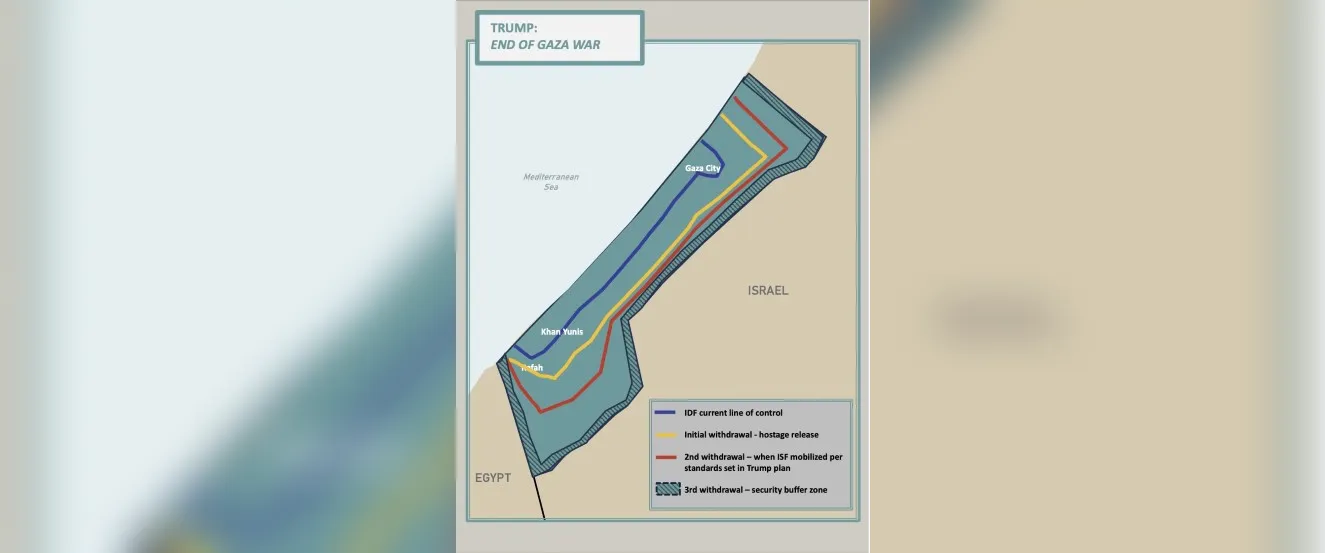
This brings up the question of the declaration of the 'New Border' on the sidelines of this agreement, which echoes the West Bank annexation. The agreement states that the IDF will hand over Gaza territory to the International Stabilization Force (ISF), which will be temporarily developed under the US and partnered effort from the Arab and other international partners. The ISF will be deployed to train the Palestinian police forces for a long-term internal security solution. During the war, the IDF had taken control of over 75% of Gaza territory, and according to the first phase roll-out, the withdrawal of the IDF to the ceasefire line still gives them 53% of the Gaza territory. Let's not overlook the recent violations of ceasefire by both the parties. Subsequently, the next phase will further push IDF to the 2nd withdrawal line, when the ISF is mobilised, and then move to the 3rd withdrawal, creating a security buffer zone between Gaza and Israel, controlled by the IDF. This is highly feared by the Palestinians as the IDF has started planting concrete yellow markers, defining the yellow line in Gaza, prompting the civilians it might become the permanent border.
Additionally, although the international community seeks for a peaceful solution to the Gaza conflict, the interference of other major players brings a sense of doubt. Historically, the US has been a part of the initiatives to establish peace in other smaller nations too, like Afghanistan, which failed tremendously. Similar to how Taliban was kept out of the role in Afghan governance, it had a violent backfire. Therefore, there is a possibility that the situation might repeat itself in the case of Hamas, where some of the Hamas leadership is resisting disarmament, undermining a stable outcome. Thus, the peace building process in Gaza largely depends on coordinated international support and unwavering commitment. Multiple challenges like the US-Russia tensions, Iran factor, Arab region's constant support, and local mistrust management, are the considerations that need due attention. Other stakeholders within Palestine and Israel, like smaller militant factions, breakaway Hamas elements, and Israeli nationalist groups, also have the capability to disrupt the peace process to accomplish their own agendas.
Further, the agreement totally ignores the 'two-state solution' which has been the central consensus accepted by the international community to resolve the issue. The absence of this adds on to the complexity of reaching a conclusion in this regard because it overlooks the Palestinian right and the guarantees about the statehood. In recent years, the government of Israel under Netanyahu, and the US administration under Trump, have refuted the two-state solution as a solution to the conflict. Netanyahu stated that Palestinians have full right to govern themselves in a peaceful means, but a sovereign state has military capability, and they cannot have the means to threaten Israel's survival. That power of providing security remains with Israel. The total disregard to the two-state solution ignores the Palestinian ambition to have a sovereign state and complicates the Israeli-Palestinian consensus stability.
The second phase of the Gaza Peace Deal gives way to the redevelopment of the Gaza Strip, currently devastated by extreme bombing and warfare, full of rubble and debris. The agreement covers that consistent rehabilitation of infrastructure, to redevelop water, electricity, sewage lines, along with critical infrastructure including hospitals and markets, will be done with clearing of the rubble and reconstructing roads. Further, it also provides the agreement on the development of special economic zones for trade and investment activities in Gaza, and a Trump Economic Development Plan will recreate Gaza just like some other modern Middle East cities. While redeveloping Gaza is the most crucial point in establishing long-lasting peace, the plan fails to address the amount or the sources for funding the reconstruction. This highlights serious risks that could undermine rebuilding of Gaza, especially when Trump's private firms have been accused of corruption and making millions from the Middle East through multimillion-dollar partnerships, licensing agreements, and real estate ventures, in these modern cities.
Conclusion
The 20-Point Plan to establish peace in Gaza is a highly ambitious step that aims to take some concrete steps to address the ongoing conflict. At the same time, the world is looking at the genocide of the people in Gaza who are being forced to leave their homes that have turned into rubble. The entire Gaza strip is in ruins and the images look straight out of some movie set, yet this is the reality for the people living there in unimaginable conditions. The people in Gaza look for an immediate but lasting solution for the conflict. It can be achieved by strict adherence to the ceasefire, ironing out all the points of contention with all the stakeholders including Hamas and the Palestinian authorities, and ensuring robust international oversight. Failing to address the issues of governance legitimacy and political recognition, especially neglecting the two-state solution pose high chances of instability in the region. If these issues remain neglected, it may not lead to a lasting peace and the conflict will continue for many years to come. But, for now, the Gaza Peace Deal is a diplomatic milestone having achieved the agreement from both Hamas and Israel on certain terms. The current plan is ambitious; however, it remains a critical test for all the stakeholders.
(Nehal Sharma is an MA International Studies student at Symbiosis School of International Studies, Pune)