.png)

.jpg)
The Flair of Deception: Analysing The Art Of War
M Vasundhara
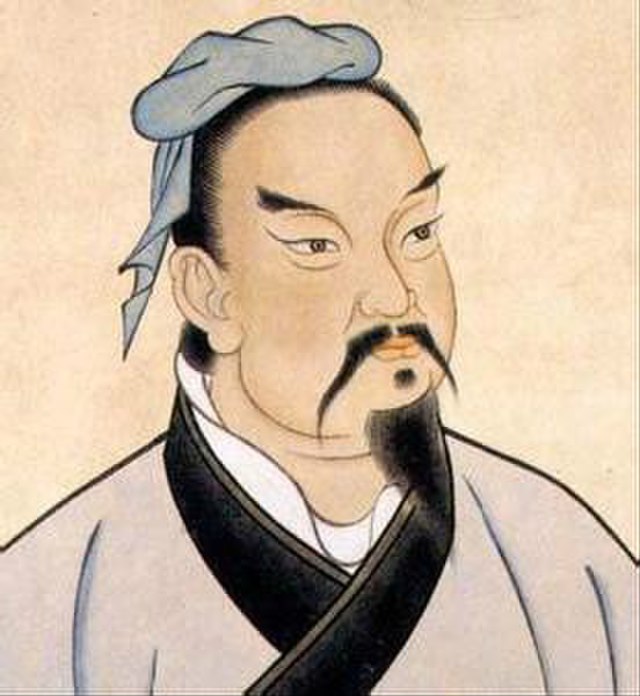
Sun Tzu
Credits : Wikimedia Commons
This analytical essay constructs arguments around the enduring relevance and real-world applications of Sun Tzu's timeless wisdom from The Art of War. Rather than a traditional book review focused on summarising the text, it aims to critically explore how Sun Tzu's strategic principles resonate within contemporary geopolitical dynamics and security challenges.
In an anarchic multilateral world up for grabs, The Art of War by the 5th century BCE Chinese military strategist and general Sun Tzu is a true testimony of hard power politics. However, the reliance on Sun Tzu's ancient theories to explain modern multilateral complexities is insightful, yet it risks oversimplification given the vastly different political, economic, and technological contexts of today. It not only relates to traditional military and economic security environment but also enhances the significance of diplomacy and "smart power" to tackle unique challenges of a non-traditional security environment, influenced by a variety of non-state actors (MNC competition, supranational entities such as EU, 1.5 track diplomacy, interactions of welfarism and extremism) while pursuing national interests. This essay attempts to critically analyse and understand the many lessons of this guide to not just war but human life, while drawing parallels between its strategies, concepts and the international relations of the 21st century CE.
War, the Last Option?
While Sun Tzu rightly highlights the cost of war and the strategic preference for alternatives, the application of classical maxims can sometimes obscure the unpredictable human and ethical dimensions of modern conflict.
All decisions whether political or not, even though "Personal is political" (Carol Hanisch 1969), require foreknowledge. This has been highlighted by Sun Tzu as costs of war, where it is calculated as being more expensive than paying spies. It should thereby be the last means of foreign policy. Appealing to the greed of your enemies, creating conspiracy, taking advantage of aggrieved officials of the enemy, divide and conquer and other tactics can avoid bloodshed, not because one is scared of fighting but because war does not always determine stability and peace. It takes a toll on the economic as well as emotional health of the citizenry, risking legitimacy of the sovereign as well as the army.
"If you know the enemy and know yourself, you need not fear the result of a hundred battles." Prerequisite to war is also the knowledge of external (enemy plus allies of your enemies) as well as internal security environment. The Vietnam War is the prime example of underestimation of domestic politics and public opinion that led America into the failure of 1975. We can take this concept forward by utilising Chanakya's Mandala theory, "your neighbor is your natural enemy and the neighbor's neighbor is your friend," competition for resources in limited geography and the concentric circle of geopolitics. However, not everything can be pre-planned. War is unpredictable; trusting your gut and acts of surprises are key features of stratagem.
Heavens & Earth
The Art of War underlines the key determinants of planning and executing war strategies:
The moral law: people to be in complete accord with the ruler to legitimise actions, ensure obedience and internal security. Kofi Annan talks about "responsibility to act" as a response to failure in conducting the basic social contract duties of the state. Humanitarian intervention by the international community (peacemaking, aid and assistance) is a strong reaction to failure in ensuring this moral law.
Heaven: weather patterns, seasonal cycles. COVID-19 as an unusual change in global dynamics rendered the world locked down, into isolation and protectionism.
Earth: geography not only becomes important to determine enemies and allies but also to gain strategic advantage. China's BRI, a global infrastructure project, is a direct reflection of how maritime influence and more importantly dependency on the dragon by countries spread out across the world gives her the control to disrupt international supply chains. It doesn't even require converting ports into military bases; China can simply declare blockade to pressure adversaries in trade wars.
The commander: leadership not only militarily but politically influences peace and prosperity. It was the vision of India's constitutional fathers that led her into a healthy democracy, realist courage and boldness to acquire the INDO-US 123 nuclear deal and the stratagem of army generals, such as Major Vikram Batra to victory at Kargil 1999.
Method and discipline: both intention as well as procedure determine results. The UN is demanding reforms today exactly for the decision-making process, the controversial veto powers and lack of implementation powers even after passing resolutions and judgements (failure in compliance by Russia and Israel) requiring states to follow international law.
Mixing War and Politics? Sovereign vs General
Sun Tzu's strict separation of politics and military authority invites critical debate, especially in an era where civil-military relations and hybrid threats challenge such clear distinctions.
Sun Tzu strictly separates politics from military authorities. This leads us to authoritarian debates, specifically Machiavelli and his "Prince," Hobbes and his absolute sovereign and Plato's "philosopher king." Phenomena such as the functionalist slicing of sovereignty, leading to supranational entities such as the EU, complicate this separation and blurring of roles.
Art of Deception: Trojan Horse in Realpolitik
This book has infamously popularised the strategy of lying and concealing not just from the enemies but your own soldiers for the greater common good (Utilitarianism - Jeremy Bentham 1789). Secrecy and ignorance to avoid treachery, discipline and punishment to keep obedience intact, are just some of the mechanisms to keep domestic politics in line. So does this now mean corrupt and manipulative politicians are actually beneficial?
Seduction has been understood as the most powerful tool of foreign policy ("Seduction is always more effective than coercion" Joseph Nye, 2012). A good example could be Cleopatra's political and military gains against Julius Caesar, using her intellect and seduction to overcome open confrontation. Spies of unique character are thus planted to extract intelligence and disseminate misinformation. We can draw parallels between Sun Tzu and Kautilyan statecraft here, Arthashastra - persuasion, inducement, punishment, and division, and more importantly his well-operated espionage system, are means of maintaining a prosperous and resilient political economy.
Asymmetric warfare mentions disrupting communication channels and allowing miscalculations/underestimation in regard to the domestic army only to later manipulate the element of surprise. The 9/11 attacks were an extreme execution of this with ideologically and religiously engineered elements of terror and revenge. This leads to blurring the lines of "Just War" (Jus ad Bellum, Thomas Aquinas), when Sun Tzu justifies hiding and deceiving, confusing and lying, dropping fire from above and attacking while enemy is in panic, unprepared, creating disorder and anxiety through humiliation or flattery where "offense is the best defence."
SHUI-JAN: Strategic Flexibility in Modern Context
We also try to answer the question of strategic advantage - quantitative vs qualitative capabilities, which is better? The new phenomena of technology and AI revolution along with greater influence of non-state actors has led to unique processes such as nuclear deterrence (nuclear capabilities of both India and Pakistan has made conventional warfare, where the former has an obvious quantitative advantage, an impossibility. It however does not stop the two natural enemies from complicating geopolitics in other international collaborations, e.g., SAARC), misinformation propaganda to shift opinions against governments, unmanned automated warfare (remote killing of Iranian nuclear scientist by Israel). This requires manoeuvres of a snake. Retreating when needed requires more courage; fleeing the battleground when needed is not a sign of cowardice but presence of mind to lose the battle but win the war.
Conclusion
Although termed 'timeless wisdom,' it is important to critically assess which elements of Sun Tzu's work remain applicable and which may be outdated or need reinterpretation in light of contemporary global norms, including international law and humanitarian considerations.
The "timeless wisdom" of Sun Tzu has been transferred today centuries later not just via Chinese diplomacy but universally as a political, military and life lesson for state and non-state actors alike. Unique manoeuvres such as silence, ambiguity (as done during Sino-Indo border talks to create confusions regarding boundaries), dramatisation, humiliation, flattery, threat and fear of veto, establishing position of control and anxiety, intelligence gathering and hierarchical structures in society as a tool of domestic as well as foreign policy are a direct reflection of this.
The dragon has arrived on the world stage today as the "Asian giant" to self-proclaim power and take revenge for its "century of humiliation." A brewing neo-cold war between America and China will require going back to the lessons of The Art of War to understand symbolic as well as practical implications in an evolved geopolitical environment, to strike a balance between the developed north and emerging south.
M Vasundhara is a master's student at the Symbiosis School of International Studies, Symbiosis International University