.png)

.jpg)
The Rise of Extreme Right In Europe
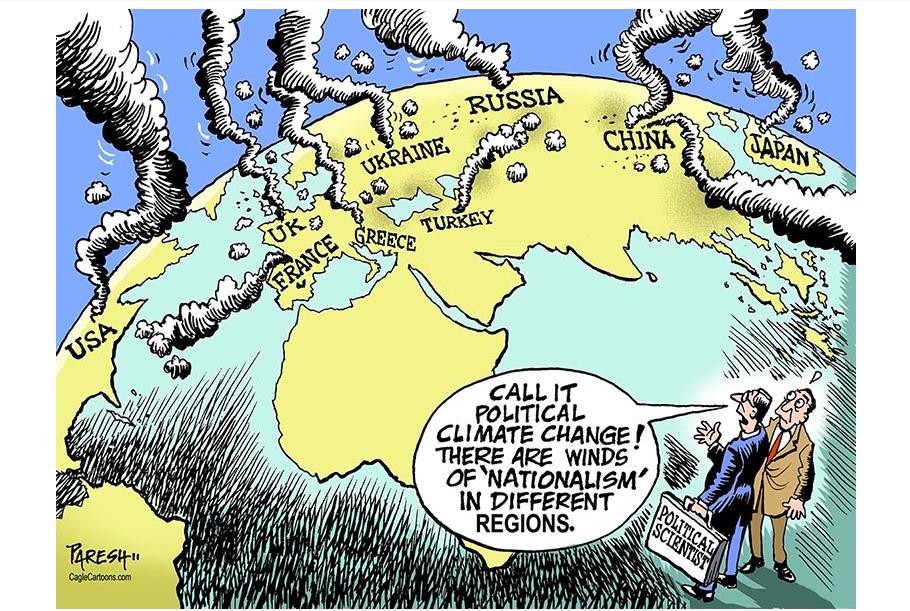
IMAGE SOURCE: https://www.cartooningforpeace.org/en/editos/far-right-turn-in-europe/
The resurgence of the right across the world is a phenomenon worth analysing. Europe has been no exception to this and the soaring popularity of leaders like Boris Johnson, Nigel Farage, Marine le Pen, Viktor Orban and Sebastian Kurz has consolidated and solidified the rise of the right on the political landscape. Events post 2008 financial crisis, Eurozone crisis, the 2015 refugee crisis, Brexit and now the Covid pandemic have aggravated the surge of right on the political spectrum of Europe. From a centre-right perspective, this is a complex phenomenon that needs to be understood in the context of the changing political landscape in Europe.
The rise of populism has given a new life to the political right in Europe which has in turn also fuelled many tensions in the form of xenophobia, islamophobia and waves of anti-refugee hatred. While these acts have been characterized by the extreme right, one needs to take into consideration the role of centre-right politics that is accommodative but also stresses upon national importance. Angela Merkel's Christian Democratic Union of Germany (CDU) defeat has dented the base of the centre-right, which has moved towards the left or to the extreme right party of Alternative fur Deutschland (AfD).
In this regard, these ideological underpinnings also affect the economic policies, which reflect the turn to extreme right. Calls for protectionism are growing louder, with European unity being threatened. Frexit, Grexit and Brexit are some concepts being propelled with the rise of the extreme right. The centre- right cares for its domestic industries but is internationalist in nature unlike the far-right.
Another important observation under the rise of the extreme right has been the consolidation of power by leaders and the erosion of institutions eventually moving towards authoritarian rule. Hungary under Viktor Orban has seen this tendency, while we see Poland moving towards this direction, as the European Union (EU) has condemned erosion of its democratic credentials.
The social discord in countries is also being challenged on the pretext of immigration control and minority population growth. Rasmus Paludan, the leader of Stram Kurs has been involved in various Quran burning incidents across Sweden, which eventually led to communal riots in Malmo and Ronneby. This shows the level of hatred that has been propelled under the guise of protest against immigration of Muslims. Rather, parties like the CDU have shown much greater tolerance when it allowed the settlement of a million refugees.
Highlighting the immigration policy adopted by the government of Denmark. In recent years, Denmark has implemented several measures designed to control immigration and ensure that new arrivals are able to integrate successfully into Danish society. These measures include language classes, job training, and a focus on shared values and cultural integration Rights for LGBTQ+ are also under the threat, because of strong emphasis on culture and Christianity. Focus on religious and cultural aspects has also led to roll back of abortion rights as has been the case of Poland under the Law and Justice Party. Similarly, the perceived threat to national identity and sovereignty posed by the European Union (EU) has also contributed to the rise of right-wing movements in Europe. The EU has an important role to play in promoting economic and political cooperation among European countries. However, there is a concern that the EU has become too bureaucratic and centralised, and that it is undermining the ability of member states to make decisions that reflect their own national interests.
One example of a centre-right approach to the EU is the policy adopted by the government of Hungary. While Hungary has been criticised for its approach to immigration and civil liberties, it has also taken a strong stance on the need for national sovereignty and the protection of Hungarian identity. This has included a refusal to accept EU quotas for refugee resettlement, as well as a focus on promoting Hungarian culture and traditions.
It is important to recognise that the rise of right-wing movements in Europe is not a monolithic phenomenon. There are significant differences between the various movements and parties that make up this broad category, and each has its own unique history, ideology, and policy agenda. However, many of these movements share some common themes and concerns.
In responding to these challenges, it is important to promote the values of freedom, democracy, and human dignity, while also recognising the legitimate concerns of citizens. This means addressing the concerns of those who feel neglected by the political establishment, without resorting to divisive and intolerant politics. It also means recognising the economic and social benefits of immigration, while also taking steps to address the challenges that it poses.
In conclusion, the rise of right-wing movements in Europe is a complex and multifaceted phenomenon that requires a nuanced and thoughtful response. From a centre-right perspective, it is important to recognise the legitimate concerns of citizens, while also promoting the values of freedom, democracy, and human dignity. Only by doing so can we build a Europe that is inclusive, tolerant, and prosperous for all.